General Questions — Part 4 (Questions 151–200)
German History: Nazi Era, WWII, Post-War Period
Question 151
Deutsch: Wer baute die Mauer in Berlin? English: Who built the Berlin Wall?
| Deutsch | English | |
|---|---|---|
| ○ | Großbritannien | Great Britain |
| ○ | die Bundesrepublik Deutschland | the Federal Republic of Germany |
| ✅ | die DDR | the GDR |
| ○ | die USA | the USA |
📝 Explanation: The GDR (East Germany) built the Berlin Wall in 1961 to stop mass emigration to the West.
Question 152
Deutsch: Wann waren die Nationalsozialisten mit Adolf Hitler in Deutschland an der Macht? English: When were the National Socialists with Adolf Hitler in power in Germany?
| Deutsch | English | |
|---|---|---|
| ○ | 1918 bis 1923 | 1918 to 1923 |
| ○ | 1932 bis 1950 | 1932 to 1950 |
| ✅ | 1933 bis 1945 | 1933 to 1945 |
| ○ | 1945 bis 1989 | 1945 to 1989 |
📝 Explanation: The Nazi regime held power from 1933 (Hitler's appointment as Chancellor) to 1945 (Germany's defeat in WWII).
Question 153
Deutsch: Was war am 8. Mai 1945? English: What happened on May 8, 1945?
| Deutsch | English | |
|---|---|---|
| ○ | Tod Adolf Hitlers | Death of Adolf Hitler |
| ○ | Beginn des Berliner Mauerbaus | Start of the Berlin Wall's construction |
| ○ | Wahl von Konrad Adenauer zum Bundeskanzler | Election of Konrad Adenauer as Chancellor |
| ✅ | Ende des Zweiten Weltkriegs in Europa | End of WWII in Europe |
📝 Explanation: May 8, 1945 marks Germany's unconditional surrender, ending World War II in Europe.
Question 154
Deutsch: Wann war der Zweite Weltkrieg zu Ende? English: When did World War II end?
| Deutsch | English | |
|---|---|---|
| ○ | 1933 | 1933 |
| ✅ | 1945 | 1945 |
| ○ | 1949 | 1949 |
| ○ | 1961 | 1961 |
📝 Explanation: World War II ended in 1945.
Question 155
Deutsch: Wann waren die Nationalsozialisten in Deutschland an der Macht? English: When were the National Socialists in power in Germany?
| Deutsch | English | |
|---|---|---|
| ○ | 1888 bis 1918 | 1888 to 1918 |
| ○ | 1921 bis 1934 | 1921 to 1934 |
| ✅ | 1933 bis 1945 | 1933 to 1945 |
| ○ | 1949 bis 1963 | 1949 to 1963 |
📝 Explanation: The Nazi regime governed Germany from 1933 to 1945.
Question 156
Deutsch: In welchem Jahr wurde Hitler Reichskanzler? English: In what year did Hitler become Reich Chancellor?
| Deutsch | English | |
|---|---|---|
| ○ | 1923 | 1923 |
| ○ | 1927 | 1927 |
| ✅ | 1933 | 1933 |
| ○ | 1936 | 1936 |
📝 Explanation: Hitler became Reich Chancellor in 1933, appointed by President Hindenburg.
Question 157
Deutsch: Die Nationalsozialisten mit Adolf Hitler errichteten 1933 in Deutschland … English: In 1933, the National Socialists with Adolf Hitler established in Germany …
| Deutsch | English | |
|---|---|---|
| ✅ | eine Diktatur. | a dictatorship. |
| ○ | einen demokratischen Staat. | a democratic state. |
| ○ | eine Monarchie. | a monarchy. |
| ○ | ein Fürstentum. | a principality. |
📝 Explanation: The Nazis established a dictatorship, abolishing democratic institutions and civil liberties.
Question 158
Deutsch: Das „Dritte Reich" war eine … English: The "Third Reich" was a …
| Deutsch | English | |
|---|---|---|
| ✅ | Diktatur. | Dictatorship. |
| ○ | Demokratie. | Democracy. |
| ○ | Monarchie. | Monarchy. |
| ○ | Räterepublik. | Council republic. |
📝 Explanation: The "Third Reich" (Nazi Germany, 1933-1945) was a dictatorship under Hitler.
Question 159
Deutsch: Was gab es in Deutschland nicht während der Zeit des Nationalsozialismus? English: What did NOT exist in Germany during the Nazi era?
| Deutsch | English | |
|---|---|---|
| ✅ | freie Wahlen | free elections |
| ○ | Pressezensur | press censorship |
| ○ | willkürliche Verhaftungen | arbitrary arrests |
| ○ | Verfolgung der Juden | persecution of Jews |
📝 Explanation: Free elections did NOT exist under Nazi rule — censorship, arbitrary arrests, and persecution were widespread instead.
Question 160
Deutsch: Welcher Krieg dauerte von 1939 bis 1945? English: Which war lasted from 1939 to 1945?
| Deutsch | English | |
|---|---|---|
| ○ | der Erste Weltkrieg | World War I |
| ✅ | der Zweite Weltkrieg | World War II |
| ○ | der Vietnamkrieg | the Vietnam War |
| ○ | der Golfkrieg | the Gulf War |
📝 Explanation: World War II lasted from 1939 to 1945.
Question 161
Deutsch: Was kennzeichnete den NS-Staat? Eine Politik … English: What characterized the Nazi state? A policy …
| Deutsch | English | |
|---|---|---|
| ✅ | des staatlichen Rassismus | of state racism |
| ○ | der Meinungsfreiheit | of freedom of speech |
| ○ | der allgemeinen Religionsfreiheit | of general freedom of religion |
| ○ | der Entwicklung der Demokratie | of developing democracy |
📝 Explanation: State racism was a defining feature of the Nazi regime, underpinning its persecution policies — the opposite of free speech, religious freedom, or democracy.
Question 162
Deutsch: Claus Schenk Graf von Stauffenberg wurde bekannt durch … English: Claus Schenk Graf von Stauffenberg became known for …
| Deutsch | English | |
|---|---|---|
| ○ | eine Goldmedaille bei den Olympischen Spielen 1936. | a gold medal at the 1936 Olympics. |
| ○ | den Bau des Reichstagsgebäudes. | building the Reichstag building. |
| ○ | den Aufbau der Wehrmacht. | building up the Wehrmacht. |
| ✅ | das Attentat auf Hitler am 20. Juli 1944. | the assassination attempt on Hitler on July 20, 1944. |
📝 Explanation: Stauffenberg led the failed July 20, 1944 assassination attempt on Hitler, a key act of German resistance to Nazism.
Question 163
Deutsch: In welchem Jahr zerstörten die Nationalsozialisten Synagogen und jüdische Geschäfte in Deutschland? English: In what year did the National Socialists destroy synagogues and Jewish businesses in Germany?
| Deutsch | English | |
|---|---|---|
| ○ | 1925 | 1925 |
| ○ | 1930 | 1930 |
| ✅ | 1938 | 1938 |
| ○ | 1945 | 1945 |
📝 Explanation: The Nazis destroyed synagogues and Jewish businesses across Germany in 1938, during the November Pogrom (Kristallnacht) on November 9, 1938.
Question 164
Deutsch: Was passierte am 9. November 1938 in Deutschland? English: What happened on November 9, 1938 in Germany?
| Deutsch | English | |
|---|---|---|
| ○ | Mit dem Angriff auf Polen beginnt der Zweite Weltkrieg. | World War II begins with the attack on Poland. |
| ○ | Die Nationalsozialisten verlieren eine Wahl und lösen den Reichstag auf. | The Nazis lose an election and dissolve the Reichstag. |
| ✅ | Jüdische Geschäfte und Synagogen werden durch Nationalsozialisten und ihre Anhänger zerstört. | Jewish businesses and synagogues are destroyed by Nazis and their supporters. |
| ○ | Hitler wird Reichspräsident und lässt alle Parteien verbieten. | Hitler becomes Reich President and bans all parties. |
📝 Explanation: November 9, 1938 was the November Pogrom ("Kristallnacht"), when Nazis and supporters destroyed Jewish synagogues and businesses across Germany.
Question 165
Deutsch: Wie hieß der erste Bundeskanzler der Bundesrepublik Deutschland? English: What was the name of the first Federal Chancellor of Germany?
| Deutsch | English | |
|---|---|---|
| ✅ | Konrad Adenauer | Konrad Adenauer |
| ○ | Kurt Georg Kiesinger | Kurt Georg Kiesinger |
| ○ | Helmut Schmidt | Helmut Schmidt |
| ○ | Willy Brandt | Willy Brandt |
📝 Explanation: Konrad Adenauer was the first Federal Chancellor of West Germany, serving from 1949 to 1963.
Question 166
Deutsch: Bei welchen Demonstrationen in Deutschland riefen die Menschen „Wir sind das Volk"? English: At which demonstrations in Germany did people chant "We are the people"?
| Deutsch | English | |
|---|---|---|
| ✅ | bei den Montagsdemonstrationen 1989 in der DDR | at the 1989 Monday demonstrations in the GDR |
| ○ | beim Arbeiteraufstand 1953 in der DDR | at the 1953 workers' uprising in the GDR |
| ○ | bei den Demonstrationen 1968 in der Bundesrepublik Deutschland | at the 1968 demonstrations in West Germany |
| ○ | bei den Anti-Atomkraft-Demonstrationen 1985 in der Bundesrepublik Deutschland | at the 1985 anti-nuclear demonstrations in West Germany |
📝 Explanation: The 1989 Monday demonstrations (Montagsdemonstrationen) in the GDR, especially in Leipzig, were key to the Peaceful Revolution that led to the Wall's fall.
Question 167
Deutsch: Welche Länder wurden nach dem Zweiten Weltkrieg in Deutschland als „Alliierte Besatzungsmächte" bezeichnet? English: Which countries were called the "Allied occupying powers" in Germany after WWII?
| Deutsch | English | |
|---|---|---|
| ○ | Sowjetunion, Großbritannien, Polen, Schweden | Soviet Union, Great Britain, Poland, Sweden |
| ○ | Frankreich, Sowjetunion, Italien, Japan | France, Soviet Union, Italy, Japan |
| ○ | USA, Sowjetunion, Spanien, Portugal | USA, Soviet Union, Spain, Portugal |
| ✅ | USA, Sowjetunion, Großbritannien, Frankreich | USA, Soviet Union, Great Britain, France |
📝 Explanation: The four Allied occupying powers were the USA, Soviet Union, Great Britain, and France, each administering a zone of postwar Germany.
Question 168
Deutsch: Welches Land war keine „Alliierte Besatzungsmacht" in Deutschland? English: Which country was NOT an "Allied occupying power" in Germany?
| Deutsch | English | |
|---|---|---|
| ○ | USA | USA |
| ○ | Sowjetunion | Soviet Union |
| ○ | Frankreich | France |
| ✅ | Japan | Japan |
📝 Explanation: Japan was not one of the four occupying powers in Germany — it was itself occupied separately after WWII.
Question 169
Deutsch: Wann wurde die Bundesrepublik Deutschland gegründet? English: When was the Federal Republic of Germany founded?
| Deutsch | English | |
|---|---|---|
| ○ | 1939 | 1939 |
| ○ | 1945 | 1945 |
| ✅ | 1949 | 1949 |
| ○ | 1951 | 1951 |
📝 Explanation: The Federal Republic of Germany (West Germany) was founded in 1949.
Question 170
Deutsch: Was gab es während der Zeit des Nationalsozialismus in Deutschland? English: What existed in Germany during the Nazi era?
| Deutsch | English | |
|---|---|---|
| ○ | das Recht zur freien Entfaltung der Persönlichkeit | the right to free personal development |
| ○ | Pressefreiheit | freedom of the press |
| ✅ | das Verbot von Parteien | the ban on political parties |
| ○ | den Schutz der Menschenwürde | protection of human dignity |
📝 Explanation: The Nazi regime banned all political parties except the NSDAP — the opposite of personal freedoms, press freedom, or human dignity protections.
Question 171
Deutsch: Soziale Marktwirtschaft bedeutet, die Wirtschaft … English: Social market economy means the economy …
| Deutsch | English | |
|---|---|---|
| ○ | steuert sich allein nach Angebot und Nachfrage. | is regulated solely by supply and demand. |
| ○ | wird vom Staat geplant und gesteuert, Angebot und Nachfrage werden nicht berücksichtigt. | is planned and controlled by the state, disregarding supply and demand. |
| ○ | richtet sich nach der Nachfrage im Ausland. | is oriented toward foreign demand. |
| ✅ | richtet sich nach Angebot und Nachfrage, aber der Staat sorgt für einen sozialen Ausgleich. | follows supply and demand, but the state ensures social balance. |
📝 Explanation: The social market economy combines free-market principles with state-provided social welfare, balancing efficiency and social equity.
Question 172
Deutsch: In welcher Besatzungszone wurde die DDR gegründet? In der … English: In which occupation zone was the GDR founded? In the …
| Deutsch | English | |
|---|---|---|
| ○ | amerikanischen Besatzungszone. | American occupation zone. |
| ○ | französischen Besatzungszone. | French occupation zone. |
| ○ | britischen Besatzungszone. | British occupation zone. |
| ✅ | sowjetischen Besatzungszone. | Soviet occupation zone. |
📝 Explanation: The GDR (East Germany) was founded in the Soviet occupation zone in 1949.
Question 173
Deutsch: Die Bundesrepublik Deutschland ist ein Gründungsmitglied … English: The Federal Republic of Germany is a founding member of the …
| Deutsch | English | |
|---|---|---|
| ○ | des Nordatlantikpakts (NATO). | North Atlantic Treaty (NATO). |
| ○ | der Vereinten Nationen (VN). | United Nations (UN). |
| ✅ | der Europäischen Union (EU). | European Union (EU). |
| ○ | des Warschauer Pakts. | Warsaw Pact. |
📝 Explanation: West Germany was a founding member of the European Economic Community, predecessor of the EU — not NATO's founding roster (joined 1955), the UN (joined 1973), or the Warsaw Pact (an Eastern Bloc alliance).
Question 174
Deutsch: Wann wurde die DDR gegründet? English: When was the GDR founded?
| Deutsch | English | |
|---|---|---|
| ○ | 1947 | 1947 |
| ✅ | 1949 | 1949 |
| ○ | 1953 | 1953 |
| ○ | 1956 | 1956 |
📝 Explanation: The GDR (East Germany) was founded in 1949, the same year as West Germany.
Question 175
Deutsch: Wie viele Besatzungszonen gab es in Deutschland nach dem Zweiten Weltkrieg? English: How many occupation zones existed in Germany after WWII?
| Deutsch | English | |
|---|---|---|
| ○ | 3 | 3 |
| ✅ | 4 | 4 |
| ○ | 5 | 5 |
| ○ | 6 | 6 |
📝 Explanation: There were 4 occupation zones, administered by the USA, Soviet Union, Great Britain, and France.
Question 176
Deutsch: Wie waren die Besatzungszonen Deutschlands nach 1945 verteilt? English: How were Germany's occupation zones divided after 1945?
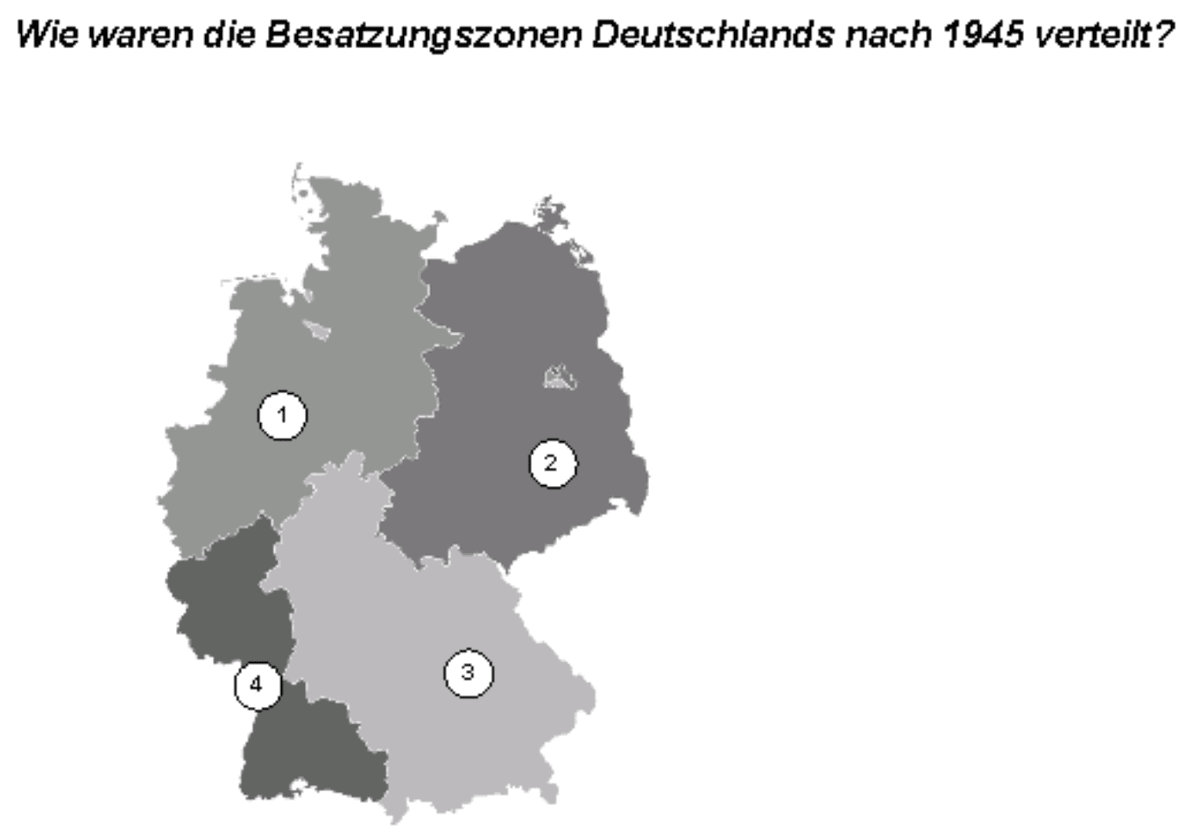
| Deutsch | English | |
|---|---|---|
| ○ | 1=Großbritannien, 2=Sowjetunion, 3=Frankreich, 4=USA | 1=Great Britain, 2=Soviet Union, 3=France, 4=USA |
| ○ | 1=Sowjetunion, 2=Großbritannien, 3=USA, 4=Frankreich | 1=Soviet Union, 2=Great Britain, 3=USA, 4=France |
| ✅ | 1=Großbritannien, 2=Sowjetunion, 3=USA, 4=Frankreich | 1=Great Britain, 2=Soviet Union, 3=USA, 4=France |
| ○ | 1=Großbritannien, 2=USA, 3=Sowjetunion, 4=Frankreich | 1=Great Britain, 2=USA, 3=Soviet Union, 4=France |
📝 Explanation: After WWII, Germany was divided into four occupation zones: British (northwest), Soviet (east), American (south), and French (southwest) — matching the numbered zones on the map as 1=Great Britain, 2=Soviet Union, 3=USA, 4=France.
Question 177
Deutsch: Welche deutsche Stadt wurde nach dem Zweiten Weltkrieg in vier Sektoren aufgeteilt? English: Which German city was divided into four sectors after WWII?
| Deutsch | English | |
|---|---|---|
| ○ | München | Munich |
| ✅ | Berlin | Berlin |
| ○ | Dresden | Dresden |
| ○ | Frankfurt/Oder | Frankfurt/Oder |
📝 Explanation: Berlin, though located within the Soviet zone, was itself divided into four Allied sectors.
Question 178
Deutsch: Vom Juni 1948 bis zum Mai 1949 wurden die Bürger und Bürgerinnen von West-Berlin durch eine Luftbrücke versorgt. Welcher Umstand war dafür verantwortlich? English: From June 1948 to May 1949, West Berlin's citizens were supplied via an airlift. What was responsible for this?
| Deutsch | English | |
|---|---|---|
| ○ | Für Frankreich war eine Versorgung der West-Berliner Bevölkerung mit dem Flugzeug kostengünstiger. | Airplane supply was cheaper for France. |
| ○ | Die amerikanischen Soldaten / Soldatinnen hatten beim Landtransport Angst vor Überfällen. | American soldiers feared ambushes during land transport. |
| ○ | Für Großbritannien war die Versorgung über die Luftbrücke schneller. | The airlift was faster for Great Britain. |
| ✅ | Die Sowjetunion unterbrach den gesamten Verkehr auf dem Landwege. | The Soviet Union cut off all land transport. |
📝 Explanation: The Soviet Union blockaded all land access to West Berlin, forcing the Western Allies to supply the city entirely by air (the Berlin Airlift).
Question 179
Deutsch: Wie endete der Zweite Weltkrieg in Europa offiziell? English: How did WWII officially end in Europe?
| Deutsch | English | |
|---|---|---|
| ○ | mit dem Tod Adolf Hitlers | with the death of Adolf Hitler |
| ✅ | durch die bedingungslose Kapitulation Deutschlands | through Germany's unconditional surrender |
| ○ | mit dem Rückzug der Deutschen aus den besetzten Gebieten | with the German withdrawal from occupied territories |
| ○ | durch eine Revolution in Deutschland | through a revolution in Germany |
📝 Explanation: WWII in Europe officially ended with Germany's unconditional surrender on May 8, 1945 — Hitler's death alone did not end the war.
Question 180
Deutsch: Der erste Bundeskanzler der Bundesrepublik Deutschland war … English: The first Federal Chancellor of Germany was …
| Deutsch | English | |
|---|---|---|
| ○ | Ludwig Erhard. | Ludwig Erhard. |
| ○ | Willy Brandt. | Willy Brandt. |
| ✅ | Konrad Adenauer. | Konrad Adenauer. |
| ○ | Gerhard Schröder. | Gerhard Schröder. |
📝 Explanation: Konrad Adenauer was the first Federal Chancellor, serving 1949-1963.
Question 181
Deutsch: Was wollte Willy Brandt mit seinem Kniefall 1970 im ehemaligen jüdischen Ghetto in Warschau ausdrücken? English: What did Willy Brandt want to express with his kneeling gesture in 1970 at the former Jewish ghetto in Warsaw?
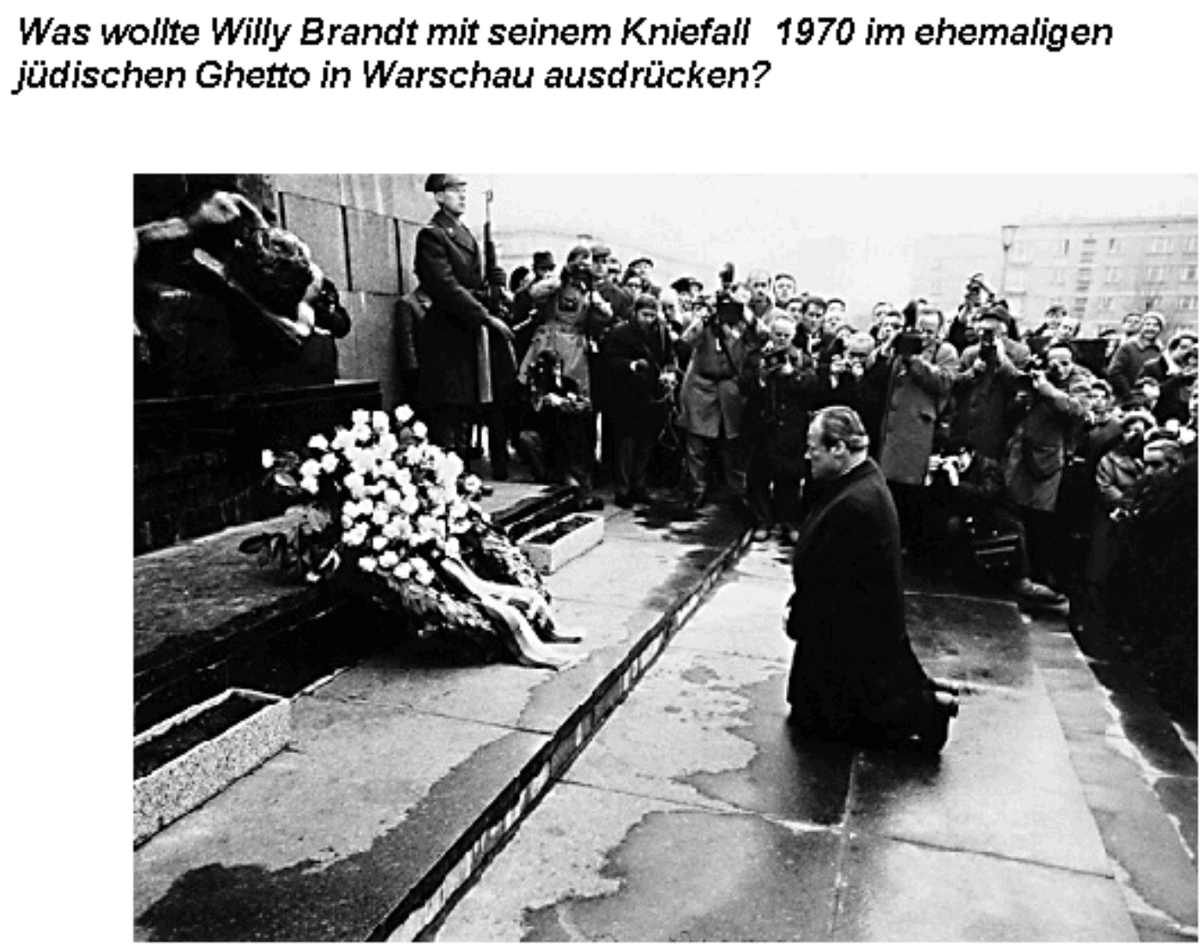
| Deutsch | English | |
|---|---|---|
| ○ | Er hat sich den ehemaligen Alliierten unterworfen. | He submitted to the former Allied powers. |
| ✅ | Er bat Polen und die polnischen Juden um Vergebung. | He asked Poland and Polish Jews for forgiveness. |
| ○ | Er zeigte seine Demut vor dem Warschauer Pakt. | He showed his humility before the Warsaw Pact. |
| ○ | Er sprach ein Gebet am Grab des Unbekannten Soldaten. | He said a prayer at the Tomb of the Unknown Soldier. |
📝 Explanation: In 1970, Chancellor Willy Brandt unexpectedly knelt at the memorial for the Warsaw Ghetto Uprising, asking forgiveness on behalf of Germany for the crimes of the Nazi era against Poland and its Jewish population. The gesture became a famous symbol of German reconciliation.
Question 182
Deutsch: Wie heißt das jüdische Gebetshaus? English: What is a Jewish house of worship called?
| Deutsch | English | |
|---|---|---|
| ○ | Basilika | Basilica |
| ○ | Moschee | Mosque |
| ✅ | Synagoge | Synagogue |
| ○ | Kirche | Church |
📝 Explanation: A synagogue is the Jewish house of worship and community gathering. Germany had over 2,000 synagogues before the Nazi era. During the November Pogrom of 1938, over 1,400 were destroyed. Today, new synagogues have been built across Germany, including notable ones in Munich (Ohel Jakob, 2006) and Dresden (2001). A basilica and church are Christian, a mosque is Islamic.
Question 183
Deutsch: Wann war in der Bundesrepublik Deutschland das „Wirtschaftswunder"? English: When was the "economic miracle" (Wirtschaftswunder) in West Germany?
| Deutsch | English | |
|---|---|---|
| ○ | 40er Jahre | the 1940s |
| ✅ | 50er Jahre | the 1950s |
| ○ | 70er Jahre | the 1970s |
| ○ | 80er Jahre | the 1980s |
📝 Explanation: West Germany's rapid postwar economic recovery, known as the Wirtschaftswunder, took place mainly in the 1950s.
Question 184
Deutsch: Auf welcher rechtlichen Grundlage wurde der Staat Israel gegründet? English: On what legal basis was the State of Israel founded?
| Deutsch | English | |
|---|---|---|
| ✅ | eine Resolution der Vereinten Nationen | a United Nations resolution |
| ○ | ein Beschluss des Zionistenkongresses | a decision of the Zionist Congress |
| ○ | ein Vorschlag der Bundesregierung | a proposal by the German Federal Government |
| ○ | ein Vorschlag der UdSSR | a proposal by the USSR |
📝 Explanation: Israel was founded on May 14, 1948, based on UN General Assembly Resolution 181 (November 29, 1947), which called for the partition of the British Mandate of Palestine into a Jewish state and an Arab state. Germany recognizes Israel's right to exist as part of its "Staatsräson" (reason of state), rooted in Germany's historical responsibility for the Holocaust.
Question 185
Deutsch: Wofür stand der Ausdruck „Eiserner Vorhang"? Für die Abschottung … English: What did the term "Iron Curtain" refer to? The isolation of …
| Deutsch | English | |
|---|---|---|
| ✅ | des Warschauer Pakts gegen den Westen. | the Warsaw Pact from the West. |
| ○ | Norddeutschlands gegen Süddeutschland. | Northern Germany from Southern Germany. |
| ○ | Nazi-Deutschlands gegen die Alliierten. | Nazi Germany from the Allies. |
| ○ | Europas gegen die USA. | Europe from the USA. |
📝 Explanation: The "Iron Curtain" symbolized the political and military barrier separating the Soviet-led Warsaw Pact bloc from Western Europe during the Cold War.
Question 186
Deutsch: Im Jahr 1953 gab es in der DDR einen Aufstand, an den lange Zeit in der Bundesrepublik Deutschland ein Feiertag erinnerte. Wann war das? English: In 1953 there was an uprising in the GDR, long commemorated by a holiday in West Germany. When was it?
| Deutsch | English | |
|---|---|---|
| ○ | 1. Mai | May 1 |
| ✅ | 17. Juni | June 17 |
| ○ | 20. Juli | July 20 |
| ○ | 9. November | November 9 |
📝 Explanation: The June 17, 1953 uprising in East Germany was commemorated as a public holiday ("Tag der Deutschen Einheit") in West Germany until reunification in 1990.
Question 187
Deutsch: Welcher deutsche Staat hatte eine schwarz-rot-goldene Flagge mit Hammer, Zirkel und Ährenkranz? English: Which German state had a black-red-gold flag with hammer, compass, and wreath of grain?
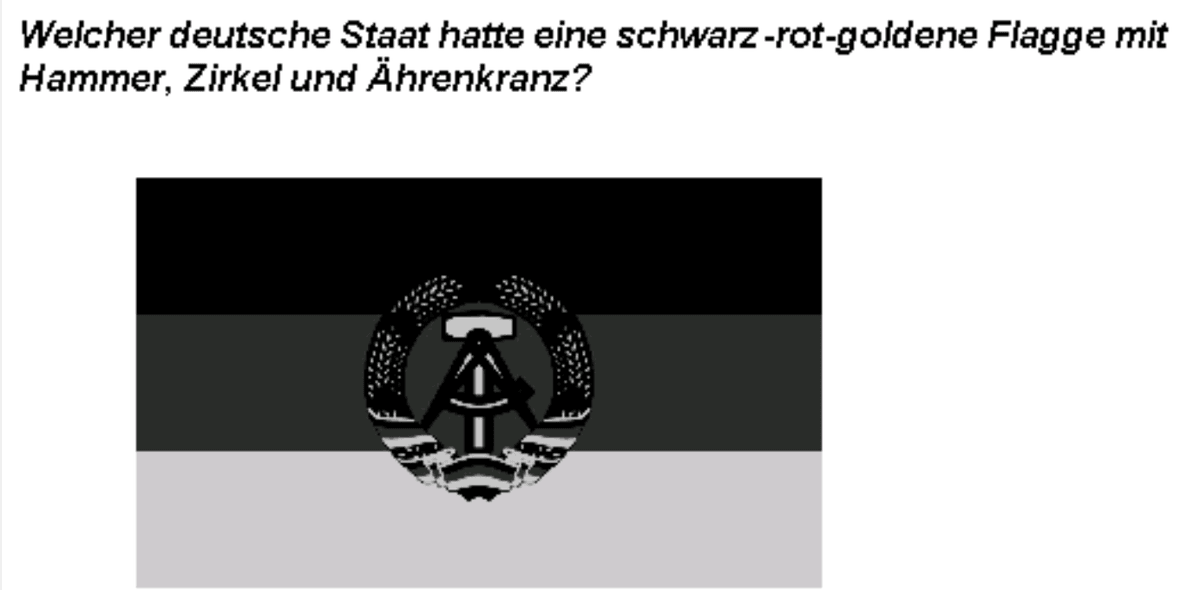
| Deutsch | English | |
|---|---|---|
| ○ | Preußen | Prussia |
| ○ | Bundesrepublik Deutschland | Federal Republic of Germany |
| ✅ | DDR | GDR |
| ○ | „Drittes Reich" | "Third Reich" |
📝 Explanation: The GDR's flag featured the hammer, compass, and wreath of grain — symbolizing workers, intellectuals, and farmers — added to the standard black-red-gold in 1959.
Question 188
Deutsch: In welchem Jahr wurde die Mauer in Berlin gebaut? English: In what year was the Berlin Wall built?
| Deutsch | English | |
|---|---|---|
| ○ | 1953 | 1953 |
| ○ | 1956 | 1956 |
| ○ | 1959 | 1959 |
| ✅ | 1961 | 1961 |
📝 Explanation: The Berlin Wall was built in 1961.
Question 189
Deutsch: Wann baute die DDR die Mauer in Berlin? English: When did the GDR build the Berlin Wall?
| Deutsch | English | |
|---|---|---|
| ○ | 1919 | 1919 |
| ○ | 1933 | 1933 |
| ✅ | 1961 | 1961 |
| ○ | 1990 | 1990 |
📝 Explanation: The GDR built the Berlin Wall in 1961.
Question 190
Deutsch: Was bedeutet die Abkürzung DDR? English: What does the abbreviation GDR stand for?
| Deutsch | English | |
|---|---|---|
| ○ | Dritter Deutscher Rundfunk | Third German Broadcasting |
| ○ | Die Deutsche Republik | The German Republic |
| ○ | Dritte Deutsche Republik | Third German Republic |
| ✅ | Deutsche Demokratische Republik | German Democratic Republic |
📝 Explanation: DDR stands for Deutsche Demokratische Republik (German Democratic Republic), the official name of East Germany.
Question 191
Deutsch: Wann wurde die Mauer in Berlin für alle geöffnet? English: When was the Berlin Wall opened for everyone?
| Deutsch | English | |
|---|---|---|
| ○ | 1987 | 1987 |
| ✅ | 1989 | 1989 |
| ○ | 1992 | 1992 |
| ○ | 1995 | 1995 |
📝 Explanation: The Berlin Wall opened on November 9, 1989.
Question 192
Deutsch: Welches heutige deutsche Bundesland gehörte früher zum Gebiet der DDR? English: Which present-day German federal state used to belong to the GDR?
| Deutsch | English | |
|---|---|---|
| ✅ | Brandenburg | Brandenburg |
| ○ | Bayern | Bavaria |
| ○ | Saarland | Saarland |
| ○ | Hessen | Hesse |
📝 Explanation: Brandenburg was part of East Germany (GDR) — Bavaria, Saarland, and Hesse were all in West Germany.
Question 193
Deutsch: Von 1961 bis 1989 war Berlin … English: From 1961 to 1989, Berlin was …
| Deutsch | English | |
|---|---|---|
| ○ | ohne Bürgermeister. | without a mayor. |
| ○ | ein eigener Staat. | its own state. |
| ✅ | durch eine Mauer geteilt. | divided by a wall. |
| ○ | nur mit dem Flugzeug erreichbar. | only accessible by plane. |
📝 Explanation: From 1961 to 1989, the Berlin Wall physically divided the city into East and West Berlin.
Question 194
Deutsch: Am 3. Oktober feiert man in Deutschland den Tag der Deutschen … English: On October 3, Germany celebrates the Day of German …
| Deutsch | English | |
|---|---|---|
| ✅ | Einheit. | Unity. |
| ○ | Nation. | Nation. |
| ○ | Bundesländer. | Federal States. |
| ○ | Städte. | Cities. |
📝 Explanation: October 3 is German Unity Day (Tag der Deutschen Einheit), commemorating reunification in 1990.
Question 195
Deutsch: Welches heutige deutsche Bundesland gehörte früher zum Gebiet der DDR? English: Which present-day German federal state used to belong to the GDR?
| Deutsch | English | |
|---|---|---|
| ○ | Hessen | Hesse |
| ✅ | Sachsen-Anhalt | Saxony-Anhalt |
| ○ | Nordrhein-Westfalen | North Rhine-Westphalia |
| ○ | Saarland | Saarland |
📝 Explanation: Saxony-Anhalt was one of the five states forming East Germany.
Question 196
Deutsch: Warum nennt man die Zeit im Herbst 1989 in der DDR „Die Wende"? In dieser Zeit veränderte sich die DDR politisch … English: Why is the autumn 1989 period in the GDR called "Die Wende" (The Turning Point)? During this time, the GDR changed politically …
| Deutsch | English | |
|---|---|---|
| ✅ | von einer Diktatur zur Demokratie. | from a dictatorship to a democracy. |
| ○ | von einer liberalen Marktwirtschaft zum Sozialismus. | from a liberal market economy to socialism. |
| ○ | von einer Monarchie zur Sozialdemokratie. | from a monarchy to social democracy. |
| ○ | von einem religiösen Staat zu einem kommunistischen Staat. | from a religious state to a communist state. |
📝 Explanation: "Die Wende" refers to the GDR's transformation from a one-party dictatorship to democracy, culminating in reunification.
Question 197
Deutsch: Welches heutige deutsche Bundesland gehörte früher zum Gebiet der DDR? English: Which present-day German federal state used to belong to the GDR?
| Deutsch | English | |
|---|---|---|
| ✅ | Thüringen | Thuringia |
| ○ | Hessen | Hesse |
| ○ | Bayern | Bavaria |
| ○ | Bremen | Bremen |
📝 Explanation: Thuringia was one of the five states forming East Germany.
Question 198
Deutsch: Welches heutige deutsche Bundesland gehörte früher zum Gebiet der DDR? English: Which present-day German federal state used to belong to the GDR?
| Deutsch | English | |
|---|---|---|
| ○ | Bayern | Bavaria |
| ○ | Niedersachsen | Lower Saxony |
| ✅ | Sachsen | Saxony |
| ○ | Baden-Württemberg | Baden-Württemberg |
📝 Explanation: Saxony was one of the five states forming East Germany.
Question 199
Deutsch: Mit der Abkürzung „Stasi" meinte man in der DDR … English: What did the abbreviation "Stasi" refer to in the GDR?
| Deutsch | English | |
|---|---|---|
| ○ | das Parlament. | the parliament. |
| ✅ | das Ministerium für Staatssicherheit. | the Ministry for State Security. |
| ○ | eine regierende Partei. | a governing party. |
| ○ | das Ministerium für Volksbildung. | the Ministry of Public Education. |
📝 Explanation: "Stasi" was the East German Ministry for State Security, the regime's secret police and intelligence agency.
Question 200
Deutsch: Welches heutige deutsche Bundesland gehörte früher zum Gebiet der DDR? English: Which present-day German federal state used to belong to the GDR?
| Deutsch | English | |
|---|---|---|
| ○ | Hessen | Hesse |
| ○ | Schleswig-Holstein | Schleswig-Holstein |
| ✅ | Mecklenburg-Vorpommern | Mecklenburg-Western Pomerania |
| ○ | Saarland | Saarland |
📝 Explanation: Mecklenburg-Western Pomerania was one of the five states forming East Germany.