General Questions — Part 2 (Questions 51–100)
Political System, Parties, Elections & Government Structure
Question 51
Deutsch: Zu einem demokratischen Rechtsstaat gehört es nicht, dass … English: It is NOT part of a democratic rule-of-law state that …
| Deutsch | English | |
|---|---|---|
| ○ | Menschen sich kritisch über die Regierung äußern können. | people can express criticism of the government. |
| ○ | Bürger friedlich demonstrieren gehen dürfen. | citizens are allowed to participate in peaceful demonstrations. |
| ✅ | Menschen von einer Privatpolizei ohne Grund verhaftet werden. | people are arrested without cause by a private police force. |
| ○ | jemand ein Verbrechen begeht und deshalb verhaftet wird. | someone commits a crime and is therefore arrested. |
📝 Explanation: In a democratic Rechtsstaat, only the state police can arrest people, and only with legal justification. A "private police" arresting people without reason would be illegal and undemocratic. Criticizing the government, peaceful demonstrations, and lawful arrests for crimes are all normal parts of a democratic society.
Question 52
Deutsch: Was bedeutet "Volkssouveränität"? Alle Staatsgewalt geht vom … English: What does "popular sovereignty" mean? All state authority emanates from the …
| Deutsch | English | |
|---|---|---|
| ✅ | Volke aus. | people. |
| ○ | Bundestag aus. | Bundestag. |
| ○ | preußischen König aus. | Prussian king. |
| ○ | Bundesverfassungsgericht aus. | Federal Constitutional Court. |
📝 Explanation: "Volkssouveränität" (popular sovereignty) is established in Article 20 of the Basic Law: "Alle Staatsgewalt geht vom Volke aus" — "All state authority emanates from the people." This means the people are the ultimate source of political power. They exercise this power through elections and votes. The Bundestag represents the people, but the power originates from the citizens themselves.
Question 53
Deutsch: Was bedeutet "Rechtsstaat" in Deutschland? English: What does "Rechtsstaat" (rule of law) mean in Germany?
| Deutsch | English | |
|---|---|---|
| ○ | Der Staat hat Recht. | The state is right. |
| ○ | Es gibt nur rechte Parteien. | There are only right-wing parties. |
| ○ | Die Bürgerinnen und Bürger entscheiden über Gesetze. | Citizens decide on laws. |
| ✅ | Der Staat muss die Gesetze einhalten. | The state must abide by the laws. |
📝 Explanation: "Rechtsstaat" literally translates to "law state" or "state of law." It means the state and all its institutions are bound by law — the government cannot act arbitrarily but must follow legal rules. This is different from "the state is right" (a common misunderstanding) or "only right-wing parties" (a play on the word "Recht" which can mean both "law/right" and "right-wing").
Question 54
Deutsch: Was ist keine staatliche Gewalt in Deutschland? English: Which is NOT a branch of state power in Germany?
| Deutsch | English | |
|---|---|---|
| ○ | Legislative | Legislative |
| ○ | Judikative | Judiciary |
| ○ | Exekutive | Executive |
| ✅ | Direktive | Directive |
📝 Explanation: Germany's state power is divided into three branches: Legislative (law-making), Executive (Exekutive, law-enforcing), and Judiciary (Judikative, law-interpreting). "Direktive" is not a real branch of government — it is the trick answer.
Question 55
Deutsch: Was zeigt dieses Bild? English: What does this picture show?
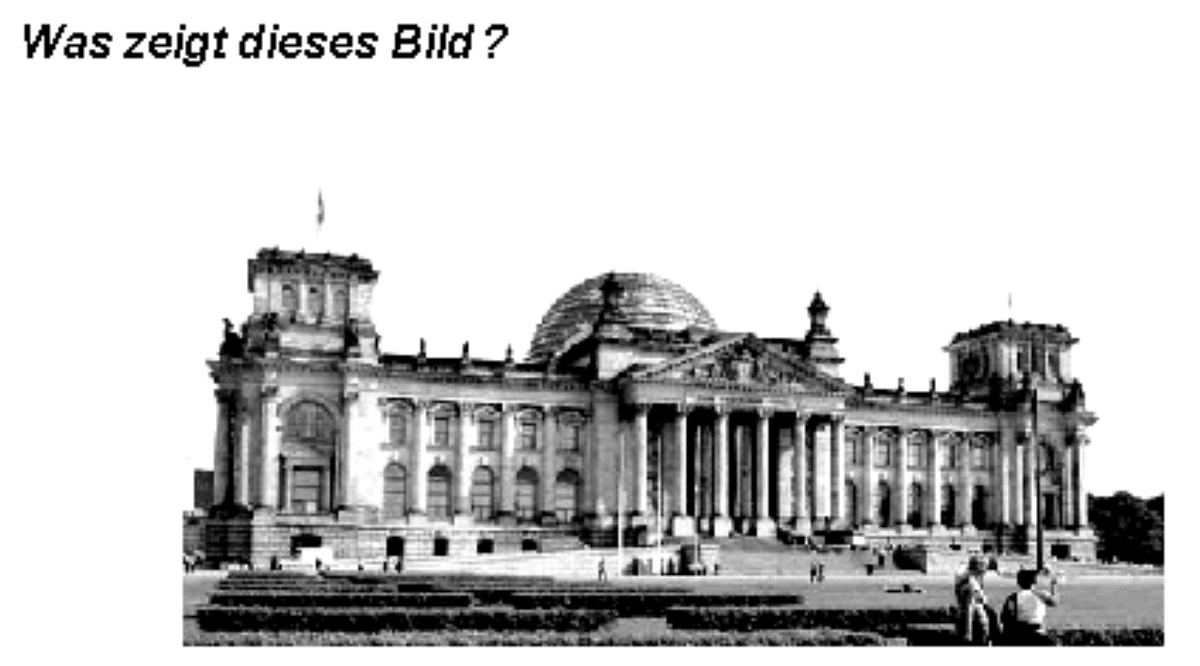
| Deutsch | English | |
|---|---|---|
| ✅ | den Bundestagssitz in Berlin | the seat of the Bundestag in Berlin |
| ○ | das Bundesverfassungsgericht in Karlsruhe | the Federal Constitutional Court in Karlsruhe |
| ○ | das Bundesratsgebäude in Berlin | the Bundesrat building in Berlin |
| ○ | das Bundeskanzleramt in Berlin | the Federal Chancellery in Berlin |
📝 Explanation: The picture shows the Reichstag building in Berlin, which houses the German Bundestag (federal parliament) — recognizable by its glass dome.
Question 56
Deutsch: Welches Amt gehört in Deutschland zur Gemeindeverwaltung? English: Which office belongs to municipal administration in Germany?
| Deutsch | English | |
|---|---|---|
| ○ | Pfarramt | Parish office |
| ✅ | Ordnungsamt | Public order office |
| ○ | Finanzamt | Tax office |
| ○ | Auswärtiges Amt | Federal Foreign Office |
📝 Explanation: The Ordnungsamt (public order office) is a municipal authority responsible for local public order and safety. The Pfarramt is religious, the Finanzamt is a state tax office, and the Auswärtiges Amt is the federal foreign ministry — none are municipal.
Question 57
Deutsch: Wer wird meistens zum Präsidenten / zur Präsidentin des Deutschen Bundestages gewählt? English: Who is usually elected President of the German Bundestag?
| Deutsch | English | |
|---|---|---|
| ○ | der / die älteste Abgeordnete im Parlament | the oldest member of parliament |
| ○ | der Ministerpräsident / die Ministerpräsidentin des größten Bundeslandes | the Minister-President of the largest federal state |
| ✅ | ein Abgeordneter / eine Abgeordnete der stärksten Fraktion | a member of the strongest parliamentary group |
| ○ | ein ehemaliger Bundeskanzler / eine ehemalige Bundeskanzlerin | a former Federal Chancellor |
📝 Explanation: By convention, the President of the Bundestag is a member of the strongest parliamentary group (Fraktion), not necessarily the oldest MP or a former Chancellor.
Question 58
Deutsch: Wer ernennt in Deutschland die Minister / die Ministerinnen der Bundesregierung? English: Who appoints the ministers of the federal government in Germany?
| Deutsch | English | |
|---|---|---|
| ○ | der Präsident / die Präsidentin des Bundesverfassungsgerichtes | the President of the Federal Constitutional Court |
| ✅ | der Bundespräsident / die Bundespräsidentin | the Federal President |
| ○ | der Bundesratspräsident / die Bundesratspräsidentin | the President of the Bundesrat |
| ○ | der Bundestagspräsident / die Bundestagspräsidentin | the President of the Bundestag |
📝 Explanation: The Federal President formally appoints and dismisses federal ministers, on the proposal of the Chancellor.
Question 59
Deutsch: Vor wie vielen Jahren gab es erstmals eine jüdische Gemeinde auf dem Gebiet des heutigen Deutschlands? English: How many years ago did a Jewish community first exist on the territory of present-day Germany?
| Deutsch | English | |
|---|---|---|
| ○ | vor etwa 300 Jahren | about 300 years ago |
| ○ | vor etwa 700 Jahren | about 700 years ago |
| ○ | vor etwa 1150 Jahren | about 1150 years ago |
| ✅ | vor etwa 1700 Jahren | about 1700 years ago |
📝 Explanation: Jewish communities have existed on German territory for about 1,700 years, with documented evidence dating to Roman-era Cologne in 321 CE — among the oldest Jewish settlements in Europe north of the Alps.
Question 60
Deutsch: In Deutschland gehören der Bundestag und der Bundesrat zur … English: In Germany, the Bundestag and Bundesrat belong to the …
| Deutsch | English | |
|---|---|---|
| ○ | Exekutive. | Executive. |
| ✅ | Legislative. | Legislature. |
| ○ | Direktive. | Directive. |
| ○ | Judikative. | Judiciary. |
📝 Explanation: The Bundestag and Bundesrat are both legislative bodies (Legislative) — they make laws, unlike the executive (government) or judiciary (courts).
Question 61
Deutsch: Was bedeutet „Volkssouveränität“? English: What does "popular sovereignty" mean?
| Deutsch | English | |
|---|---|---|
| ○ | Der König / die Königin herrscht über das Volk. | The king/queen rules over the people. |
| ○ | Das Bundesverfassungsgericht steht über der Verfassung. | The Federal Constitutional Court stands above the constitution. |
| ○ | Die Interessenverbände üben die Souveränität zusammen mit der Regierung aus. | Interest groups exercise sovereignty together with the government. |
| ✅ | Die Staatsgewalt geht vom Volke aus. | State power originates from the people. |
📝 Explanation: Popular sovereignty, enshrined in Article 20 of the Basic Law, means all state authority is derived from the people, exercised through elections and referenda.
Question 62
Deutsch: Wenn das Parlament eines deutschen Bundeslandes gewählt wird, nennt man das … English: When the parliament of a German federal state is elected, this is called …
| Deutsch | English | |
|---|---|---|
| ○ | Kommunalwahl. | Municipal election. |
| ✅ | Landtagswahl. | State parliament election. |
| ○ | Europawahl. | European election. |
| ○ | Bundestagswahl. | Federal election. |
📝 Explanation: Electing a state parliament (Landtag) is called a Landtagswahl, distinct from municipal, European, or federal elections.
Question 63
Deutsch: Was gehört in Deutschland nicht zur Exekutive? English: What does NOT belong to the executive branch in Germany?
| Deutsch | English | |
|---|---|---|
| ○ | die Polizei | the police |
| ✅ | die Gerichte | the courts |
| ○ | das Finanzamt | the tax office |
| ○ | die Ministerien | the ministries |
📝 Explanation: Courts belong to the judiciary (Judikative), not the executive. Police, tax offices, and ministries are all part of the executive branch.
Question 64
Deutsch: Die Bundesrepublik Deutschland ist heute gegliedert in … English: Today, the Federal Republic of Germany is organized into …
| Deutsch | English | |
|---|---|---|
| ○ | vier Besatzungszonen. | four occupation zones. |
| ○ | einen Oststaat und einen Weststaat. | an eastern state and a western state. |
| ○ | 16 Kantone. | 16 cantons. |
| ✅ | Bund, Länder und Kommunen. | Federation, states, and municipalities. |
📝 Explanation: Germany's administrative structure has three levels: the federal government (Bund), the 16 states (Länder), and local municipalities (Kommunen).
Question 65
Deutsch: Es gehört nicht zu den Aufgaben des Deutschen Bundestages, … English: It is NOT a task of the German Bundestag to …
| Deutsch | English | |
|---|---|---|
| ○ | Gesetze zu entwerfen. | draft laws. |
| ○ | die Bundesregierung zu kontrollieren. | control the federal government. |
| ○ | den Bundeskanzler / die Bundeskanzlerin zu wählen. | elect the Federal Chancellor. |
| ✅ | das Bundeskabinett zu bilden. | form the federal cabinet. |
📝 Explanation: Forming the cabinet is the Chancellor's job, not the Bundestag's. The Bundestag drafts laws, elects the Chancellor, and controls the government.
Question 66
Deutsch: Welche Städte haben die größten jüdischen Gemeinden in Deutschland? English: Which cities have the largest Jewish communities in Germany?
| Deutsch | English | |
|---|---|---|
| ✅ | Berlin und München | Berlin and Munich |
| ○ | Hamburg und Essen | Hamburg and Essen |
| ○ | Nürnberg und Stuttgart | Nuremberg and Stuttgart |
| ○ | Worms und Speyer | Worms and Speyer |
📝 Explanation: Berlin and Munich have Germany's largest Jewish communities today, reflecting post-reunification and post-Soviet immigration patterns.
Question 67
Deutsch: Was ist in Deutschland vor allem eine Aufgabe der Bundesländer? English: What is primarily a task of the federal states in Germany?
| Deutsch | English | |
|---|---|---|
| ○ | Verteidigungspolitik | Defense policy |
| ○ | Außenpolitik | Foreign policy |
| ○ | Wirtschaftspolitik | Economic policy |
| ✅ | Schulpolitik | Education policy |
📝 Explanation: Education policy (Schulpolitik) is primarily a state responsibility in Germany, unlike defense, foreign affairs, and much of economic policy, which are federal matters.
Question 68
Deutsch: Warum kontrolliert der Staat in Deutschland das Schulwesen? English: Why does the state control the school system in Germany?
| Deutsch | English | |
|---|---|---|
| ○ | weil es in Deutschland nur staatliche Schulen gibt | because there are only state schools in Germany |
| ○ | weil alle Schüler und Schülerinnen einen Schulabschluss haben müssen | because all students must have a school qualification |
| ○ | weil es in den Bundesländern verschiedene Schulen gibt | because there are different schools in the federal states |
| ✅ | weil es nach dem Grundgesetz seine Aufgabe ist | because it is the state's responsibility under the Basic Law |
📝 Explanation: State oversight of schools (Schulaufsicht) is a constitutional duty under the Basic Law, ensuring educational quality and standards nationwide.
Question 69
Deutsch: Die Bundesrepublik Deutschland hat einen dreistufigen Verwaltungsaufbau. Wie heißt die unterste politische Stufe? English: Germany has a three-tier administrative structure. What is the lowest political level called?
| Deutsch | English | |
|---|---|---|
| ○ | Stadträte | City councils |
| ○ | Landräte | District administrators |
| ✅ | Gemeinden | Municipalities |
| ○ | Bezirksämter | District offices |
📝 Explanation: The Gemeinden (municipalities) form the lowest administrative and political level in Germany's three-tier structure of Bund, Länder, and Gemeinden.
Question 70
Deutsch: Der deutsche Bundespräsident Gustav Heinemann gibt Helmut Schmidt 1974 die Ernennungsurkunde zum deutschen Bundeskanzler. Was gehört zu den Aufgaben des deutschen Bundespräsidenten / der deutschen Bundespräsidentin? English: In 1974, German President Gustav Heinemann hands Helmut Schmidt his certificate of appointment as Federal Chancellor. What is one of the duties of the German Federal President?
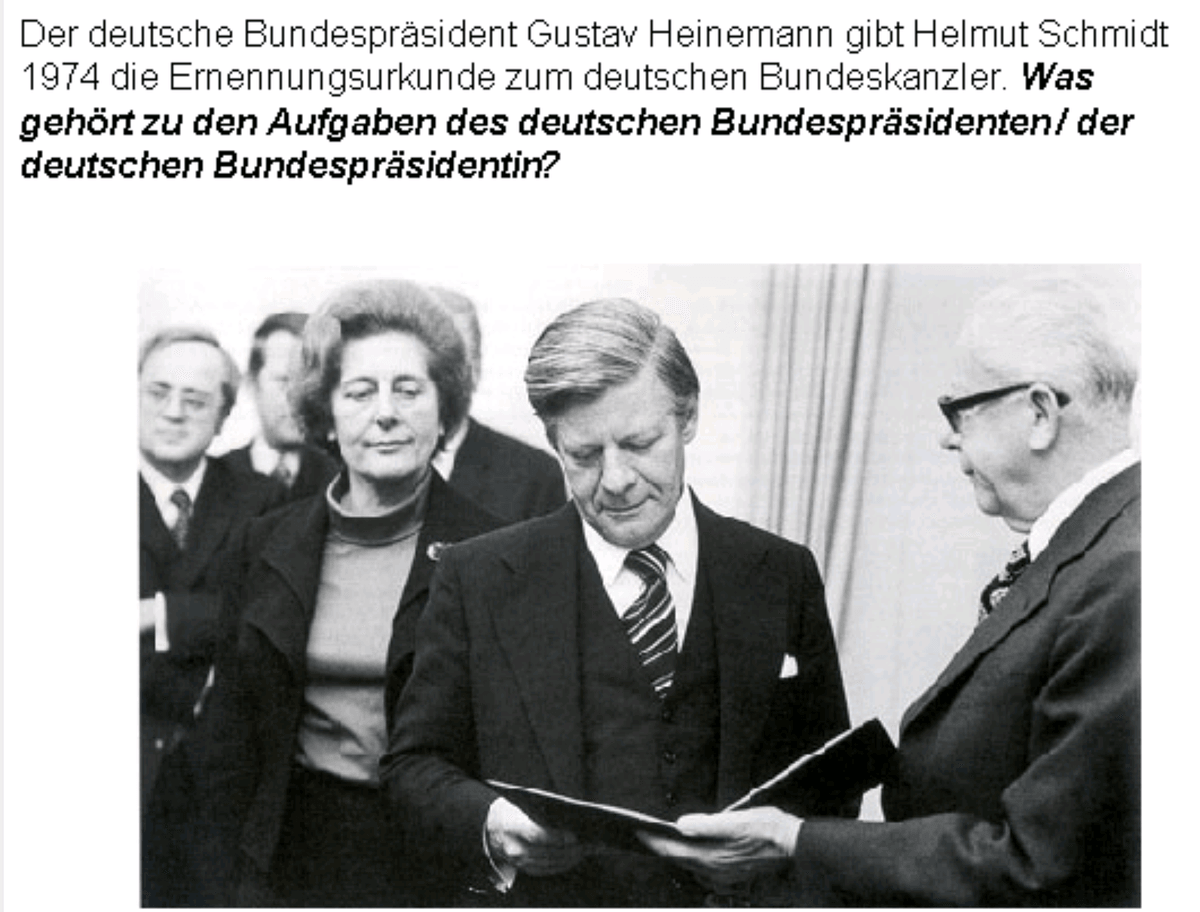
| Deutsch | English | |
|---|---|---|
| ○ | Er / Sie führt die Regierungsgeschäfte. | He/she runs the day-to-day business of government. |
| ○ | Er / Sie kontrolliert die Regierungspartei. | He/she controls the governing party. |
| ○ | Er / Sie wählt die Minister / Ministerinnen aus. | He/she selects the ministers. |
| ✅ | Er / Sie schlägt den Kanzler / die Kanzlerin zur Wahl vor. | He/she proposes the Chancellor for election. |
📝 Explanation: The Federal President proposes a candidate for Chancellor to the Bundestag for election, and formally appoints the Chancellor and ministers — but does not run the government or select ministers personally.
Question 71
Deutsch: Wo hält sich der deutsche Bundeskanzler / die deutsche Bundeskanzlerin am häufigsten auf? Am häufigsten ist er / sie … English: Where is the German Federal Chancellor most often located? He/she is most often …
| Deutsch | English | |
|---|---|---|
| ○ | in Bonn, weil sich dort das Bundeskanzleramt und der Bundestag befinden. | in Bonn, because the Chancellery and Bundestag are located there. |
| ✅ | in Berlin, weil sich dort das Bundeskanzleramt und der Bundestag befinden. | in Berlin, because the Chancellery and Bundestag are located there. |
| ○ | auf Schloss Meseberg, dem Gästehaus der Bundesregierung, um Staatsgäste zu empfangen. | at Schloss Meseberg, the government's guest house, to receive state guests. |
| ○ | auf Schloss Bellevue, dem Amtssitz des Bundespräsidenten / der Bundespräsidentin, um Staatsgäste zu empfangen. | at Schloss Bellevue, the President's official residence, to receive state guests. |
📝 Explanation: Since the government moved from Bonn to Berlin in 1999, the Chancellor is most often in Berlin, home to both the Chancellery and the Bundestag.
Question 72
Deutsch: Wie heißt der jetzige Bundeskanzler / die jetzige Bundeskanzlerin von Deutschland? English: What is the name of the current Federal Chancellor of Germany?
| Deutsch | English | |
|---|---|---|
| ○ | Gerhard Schröder | Gerhard Schröder |
| ○ | Angela Merkel | Angela Merkel |
| ○ | Ursula von der Leyen | Ursula von der Leyen |
| ✅ | Friedrich Merz | Friedrich Merz |
📝 Explanation: Friedrich Merz (CDU) has been Federal Chancellor since 2025. Note: this is a current-affairs question the real test updates periodically — always verify the current officeholder before the exam.
Question 73
Deutsch: Die beiden größten Fraktionen im Deutschen Bundestag heißen zurzeit … English: The two largest parliamentary groups in the German Bundestag are currently called …
| Deutsch | English | |
|---|---|---|
| ✅ | CDU/CSU und AfD. | CDU/CSU and AfD. |
| ○ | Die Linke und Bündnis 90/Die Grünen. | Die Linke and Bündnis 90/Die Grünen. |
| ○ | Bündnis 90/Die Grünen und SPD. | Bündnis 90/Die Grünen and SPD. |
| ○ | Die Linke und CDU/CSU. | Die Linke and CDU/CSU. |
📝 Explanation: Following the 2025 federal election, CDU/CSU and AfD are the two largest parliamentary groups. Note: this is a current-affairs question — verify before the exam, as party standings change with each election.
Question 74
Deutsch: Wie heißt das Parlament für ganz Deutschland? English: What is the parliament for all of Germany called?
| Deutsch | English | |
|---|---|---|
| ○ | Bundesversammlung | Federal Convention |
| ○ | Volkskammer | People's Chamber |
| ✅ | Bundestag | Bundestag |
| ○ | Bundesgerichtshof | Federal Court of Justice |
📝 Explanation: The Bundestag is Germany's national parliament. The Bundesversammlung only convenes to elect the President, the Volkskammer was the former East German parliament, and the Bundesgerichtshof is a court.
Question 75
Deutsch: Wie heißt Deutschlands heutiges Staatsoberhaupt? English: What is the name of Germany's current head of state?
| Deutsch | English | |
|---|---|---|
| ✅ | Frank-Walter Steinmeier | Frank-Walter Steinmeier |
| ○ | Bärbel Bas | Bärbel Bas |
| ○ | Bodo Ramelow | Bodo Ramelow |
| ○ | Joachim Gauck | Joachim Gauck |
📝 Explanation: Frank-Walter Steinmeier is Germany's Federal President (head of state). Note: this is a current-affairs question — verify the current officeholder before the exam.
Question 76
Deutsch: Was bedeutet die Abkürzung CDU in Deutschland? English: What does the abbreviation CDU stand for in Germany?
| Deutsch | English | |
|---|---|---|
| ○ | Christliche Deutsche Union | Christian German Union |
| ○ | Club Deutscher Unternehmer | Club of German Entrepreneurs |
| ○ | Christlicher Deutscher Umweltschutz | Christian German Environmental Protection |
| ✅ | Christlich Demokratische Union | Christian Democratic Union |
📝 Explanation: CDU stands for Christlich Demokratische Union (Christian Democratic Union), one of Germany's major political parties.
Question 77
Deutsch: Was ist die Bundeswehr? English: What is the Bundeswehr?
| Deutsch | English | |
|---|---|---|
| ○ | die deutsche Polizei | the German police |
| ○ | ein deutscher Hafen | a German port |
| ○ | eine deutsche Bürgerinitiative | a German citizens' initiative |
| ✅ | die deutsche Armee | the German army |
📝 Explanation: The Bundeswehr is Germany's armed forces (the military), not the police, a port, or a citizens' group.
Question 78
Deutsch: Was bedeutet die Abkürzung SPD? English: What does the abbreviation SPD stand for?
| Deutsch | English | |
|---|---|---|
| ○ | Sozialistische Partei Deutschlands | Socialist Party of Germany |
| ○ | Sozialpolitische Partei Deutschlands | Social Policy Party of Germany |
| ✅ | Sozialdemokratische Partei Deutschlands | Social Democratic Party of Germany |
| ○ | Sozialgerechte Partei Deutschlands | Social Justice Party of Germany |
📝 Explanation: SPD stands for Sozialdemokratische Partei Deutschlands (Social Democratic Party of Germany), one of Germany's oldest and largest parties.
Question 79
Deutsch: Was bedeutet die Abkürzung FDP in Deutschland? English: What does the abbreviation FDP stand for in Germany?
| Deutsch | English | |
|---|---|---|
| ○ | Friedliche Demonstrative Partei | Peaceful Demonstrative Party |
| ○ | Freie Deutschland Partei | Free Germany Party |
| ○ | Führende Demokratische Partei | Leading Democratic Party |
| ✅ | Freie Demokratische Partei | Free Democratic Party |
📝 Explanation: FDP stands for Freie Demokratische Partei (Free Democratic Party), a liberal party in Germany.
Question 80
Deutsch: Welches Gericht in Deutschland ist zuständig für die Auslegung des Grundgesetzes? English: Which court in Germany is responsible for interpreting the Basic Law?
| Deutsch | English | |
|---|---|---|
| ○ | Oberlandesgericht | Higher Regional Court |
| ○ | Amtsgericht | Local Court |
| ✅ | Bundesverfassungsgericht | Federal Constitutional Court |
| ○ | Verwaltungsgericht | Administrative Court |
📝 Explanation: The Bundesverfassungsgericht (Federal Constitutional Court), located in Karlsruhe, is responsible for interpreting the Basic Law and reviewing the constitutionality of laws.
Question 81
Deutsch: Wer wählt den Bundeskanzler / die Bundeskanzlerin in Deutschland? English: Who elects the Federal Chancellor in Germany?
| Deutsch | English | |
|---|---|---|
| ○ | der Bundesrat | the Bundesrat |
| ○ | die Bundesversammlung | the Federal Convention |
| ○ | das Volk | the people |
| ✅ | der Bundestag | the Bundestag |
📝 Explanation: The Bundestag elects the Federal Chancellor, on the proposal of the Federal President — not the people directly, the Bundesrat, or the Bundesversammlung (which only elects the President).
Question 82
Deutsch: Wer leitet das deutsche Bundeskabinett? English: Who leads the German federal cabinet?
| Deutsch | English | |
|---|---|---|
| ○ | der Bundestagspräsident / die Bundestagspräsidentin | the President of the Bundestag |
| ○ | der Bundespräsident / die Bundespräsidentin | the Federal President |
| ✅ | der Bundeskanzler / die Bundeskanzlerin | the Federal Chancellor |
| ○ | der Bundesratspräsident / die Bundesratspräsidentin | the President of the Bundesrat |
📝 Explanation: The Federal Chancellor leads the federal cabinet and determines the general policy guidelines (Richtlinienkompetenz).
Question 83
Deutsch: Wer wählt den deutschen Bundeskanzler / die deutsche Bundeskanzlerin? English: Who elects the German Federal Chancellor?
| Deutsch | English | |
|---|---|---|
| ○ | das Volk | the people |
| ○ | die Bundesversammlung | the Federal Convention |
| ✅ | der Bundestag | the Bundestag |
| ○ | die Bundesregierung | the federal government |
📝 Explanation: The Bundestag elects the Federal Chancellor — Germans do not vote for the Chancellor directly.
Question 84
Deutsch: Welche Hauptaufgabe hat der deutsche Bundespräsident / die deutsche Bundespräsidentin? Er / Sie … English: What is the main task of the German Federal President? He/she …
| Deutsch | English | |
|---|---|---|
| ○ | regiert das Land. | governs the country. |
| ○ | entwirft die Gesetze. | drafts laws. |
| ✅ | repräsentiert das Land. | represents the country. |
| ○ | überwacht die Einhaltung der Gesetze. | oversees compliance with laws. |
📝 Explanation: The Federal President's main role is representative (a largely ceremonial head of state) — the Chancellor governs, and the Bundestag drafts laws.
Question 85
Deutsch: Wer bildet den deutschen Bundesrat? English: Who makes up the German Bundesrat?
| Deutsch | English | |
|---|---|---|
| ○ | die Abgeordneten des Bundestages | the members of the Bundestag |
| ○ | die Minister und Ministerinnen der Bundesregierung | the ministers of the federal government |
| ✅ | die Regierungsvertreter der Bundesländer | government representatives of the federal states |
| ○ | die Parteimitglieder | party members |
📝 Explanation: The Bundesrat consists of representatives of the state governments (Länder), representing regional interests in federal legislation.
Question 86
Deutsch: Wer wählt in Deutschland den Bundespräsidenten / die Bundespräsidentin? English: Who elects the Federal President in Germany?
| Deutsch | English | |
|---|---|---|
| ✅ | die Bundesversammlung | the Federal Convention |
| ○ | der Bundesrat | the Bundesrat |
| ○ | das Bundesparlament | the federal parliament |
| ○ | das Bundesverfassungsgericht | the Federal Constitutional Court |
📝 Explanation: The Bundesversammlung (Federal Convention) — a special body of Bundestag members and state delegates — elects the Federal President every five years.
Question 87
Deutsch: Wer ist das Staatsoberhaupt der Bundesrepublik Deutschland? English: Who is the head of state of the Federal Republic of Germany?
| Deutsch | English | |
|---|---|---|
| ○ | der Bundeskanzler / die Bundeskanzlerin | the Federal Chancellor |
| ✅ | der Bundespräsident / die Bundespräsidentin | the Federal President |
| ○ | der Bundesratspräsident / die Bundesratspräsidentin | the President of the Bundesrat |
| ○ | der Bundestagspräsident / die Bundestagspräsidentin | the President of the Bundestag |
📝 Explanation: The Federal President is Germany's head of state, a largely ceremonial role, distinct from the Chancellor who heads the government.
Question 88
Deutsch: Die parlamentarische Opposition im Deutschen Bundestag … English: The parliamentary opposition in the German Bundestag …
| Deutsch | English | |
|---|---|---|
| ✅ | kontrolliert die Regierung. | controls the government. |
| ○ | entscheidet, wer Bundesminister / Bundesministerin wird. | decides who becomes a federal minister. |
| ○ | bestimmt, wer im Bundesrat sitzt. | determines who sits in the Bundesrat. |
| ○ | schlägt die Regierungschefs / Regierungschefinnen der Länder vor. | proposes the heads of government of the states. |
📝 Explanation: The parliamentary opposition's key role is to control and scrutinize the government — it does not appoint ministers or determine Bundesrat/state leadership.
Question 89
Deutsch: Wie nennt man in Deutschland die Vereinigung von Abgeordneten einer Partei im Parlament? English: What is the association of a party's members of parliament called in Germany?
| Deutsch | English | |
|---|---|---|
| ○ | Verband | Association |
| ○ | Ältestenrat | Council of Elders |
| ✅ | Fraktion | Parliamentary group |
| ○ | Opposition | Opposition |
📝 Explanation: A Fraktion is the parliamentary group formed by members of the same party (or allied parties) in the Bundestag.
Question 90
Deutsch: Die deutschen Bundesländer wirken an der Gesetzgebung des Bundes mit durch … English: The German federal states participate in federal legislation through …
| Deutsch | English | |
|---|---|---|
| ✅ | den Bundesrat. | the Bundesrat. |
| ○ | die Bundesversammlung. | the Federal Convention. |
| ○ | den Bundestag. | the Bundestag. |
| ○ | die Bundesregierung. | the federal government. |
📝 Explanation: The Bundesrat is the chamber through which the states participate in federal lawmaking, giving them a voice in national legislation.
Question 91
Deutsch: In Deutschland kann ein Regierungswechsel in einem Bundesland Auswirkungen auf die Bundespolitik haben. Das Regieren wird … English: In Germany, a change of government in a federal state can affect federal politics. Governing becomes …
| Deutsch | English | |
|---|---|---|
| ○ | schwieriger, wenn sich dadurch die Mehrheit im Bundestag ändert. | harder, if this changes the majority in the Bundestag. |
| ○ | leichter, wenn dadurch neue Parteien in den Bundesrat kommen. | easier, if new parties enter the Bundesrat. |
| ✅ | schwieriger, wenn dadurch die Mehrheit im Bundesrat verändert wird. | harder, if this changes the majority in the Bundesrat. |
| ○ | leichter, wenn es sich um ein reiches Bundesland handelt. | easier, if it is a wealthy federal state. |
📝 Explanation: Since state governments sit in the Bundesrat, a shift in a state election can change the Bundesrat majority, making federal governing harder if the opposition gains ground there.
Question 92
Deutsch: Was bedeutet die Abkürzung CSU in Deutschland? English: What does the abbreviation CSU stand for in Germany?
| Deutsch | English | |
|---|---|---|
| ○ | Christlich Sichere Union | Christian Secure Union |
| ○ | Christlich Süddeutsche Union | Christian South German Union |
| ○ | Christlich Sozialer Unternehmerverband | Christian Social Entrepreneurs' Association |
| ✅ | Christlich Soziale Union | Christian Social Union |
📝 Explanation: CSU stands for Christlich Soziale Union (Christian Social Union), the Bavaria-only sister party of the CDU.
Question 93
Deutsch: Je mehr „Zweitstimmen“ eine Partei bei einer Bundestagswahl bekommt, desto … English: The more "second votes" a party receives in a federal election, the …
| Deutsch | English | |
|---|---|---|
| ✅ | mehr Sitze erhält die Partei im Parlament. | more seats the party gets in parliament. |
| ○ | weniger Erststimmen kann sie haben. | fewer first votes it can have. |
| ○ | mehr Direktkandidaten der Partei ziehen ins Parlament ein. | more of the party's direct candidates enter parliament. |
| ○ | größer ist das Risiko, eine Koalition bilden zu müssen. | greater the risk of having to form a coalition. |
📝 Explanation: The Zweitstimme (second vote) determines each party's overall share of Bundestag seats — the more second votes, the more total seats.
Question 94
Deutsch: Ab welchem Alter darf man in Deutschland an der Wahl zum Deutschen Bundestag teilnehmen? English: From what age can one participate in the election to the German Bundestag?
| Deutsch | English | |
|---|---|---|
| ○ | 16 | 16 |
| ✅ | 18 | 18 |
| ○ | 21 | 21 |
| ○ | 23 | 23 |
📝 Explanation: The minimum voting age for federal (Bundestag) elections in Germany is 18.
Question 95
Deutsch: Was gilt für die meisten Kinder in Deutschland? English: What applies to most children in Germany?
| Deutsch | English | |
|---|---|---|
| ○ | Wahlpflicht | Compulsory voting |
| ✅ | Schulpflicht | Compulsory schooling |
| ○ | Schweigepflicht | Confidentiality obligation |
| ○ | Religionspflicht | Compulsory religion |
📝 Explanation: Compulsory schooling (Schulpflicht) applies to nearly all children in Germany — voting, confidentiality, and religion are not compulsory for children.
Question 96
Deutsch: Wie kann jemand, der den Holocaust leugnet, bestraft werden? English: How can someone who denies the Holocaust be punished?
| Deutsch | English | |
|---|---|---|
| ○ | Kürzung sozialer Leistungen | Reduction of social benefits |
| ○ | bis zu 100 Sozialstunden | up to 100 hours of community service |
| ○ | gar nicht, Holocaustleugnung ist erlaubt | not at all; Holocaust denial is permitted |
| ✅ | mit Freiheitsstrafe bis zu fünf Jahren oder mit Geldstrafe | with imprisonment of up to five years or a fine |
📝 Explanation: Holocaust denial is a criminal offense in Germany under §130(3) StGB (Volksverhetzung — incitement to hatred). Anyone who publicly denies, downplays, or approves of the Nazi genocide can face up to 5 years in prison or a fine. This law reflects Germany's historical responsibility for the murder of 6 million Jews. Germany takes this very seriously — it is NOT a matter of free speech but a criminal act.
Question 97
Deutsch: Was bezahlt man in Deutschland automatisch, wenn man fest angestellt ist? English: What does one automatically pay in Germany when permanently employed?
| Deutsch | English | |
|---|---|---|
| ✅ | Sozialversicherung | Social insurance |
| ○ | Sozialhilfe | Social welfare |
| ○ | Kindergeld | Child benefit |
| ○ | Wohngeld | Housing benefit |
📝 Explanation: Permanently employed workers automatically pay into social insurance (Sozialversicherung) — covering health, pension, unemployment, and long-term care.
Question 98
Deutsch: Wenn Abgeordnete im Deutschen Bundestag ihre Fraktion wechseln, ... English: When members of the German Bundestag switch parliamentary groups, ...
| Deutsch | English | |
|---|---|---|
| ✅ | kann die Regierung ihre Mehrheit verlieren. | the government can lose its majority. |
| ○ | dürfen sie nicht mehr an den Sitzungen des Parlaments teilnehmen. | they may no longer attend parliamentary sessions. |
| ○ | muss der Bundespräsident / die Bundespräsidentin zuvor sein / ihr Einverständnis geben. | the Federal President must first give consent. |
| ○ | dürfen die Wähler / Wählerinnen dieser Abgeordneten noch einmal wählen. | voters of these members may vote again. |
📝 Explanation: If enough MPs switch groups, the governing coalition can lose its parliamentary majority, since coalitions rely on a specific seat count.
Question 99
Deutsch: Wer bezahlt in Deutschland die Sozialversicherungen? English: Who pays social insurance contributions in Germany?
| Deutsch | English | |
|---|---|---|
| ✅ | Arbeitgeber / Arbeitgeberinnen und Arbeitnehmer / Arbeitnehmerinnen | employers and employees |
| ○ | nur Arbeitnehmer / Arbeitnehmerinnen | only employees |
| ○ | alle Staatsangehörigen | all citizens |
| ○ | nur Arbeitgeber / Arbeitgeberinnen | only employers |
📝 Explanation: Social insurance contributions are shared between employers and employees, each paying roughly half.
Question 100
Deutsch: Was gehört nicht zur gesetzlichen Sozialversicherung? English: What does NOT belong to statutory social insurance?
| Deutsch | English | |
|---|---|---|
| ○ | die gesetzliche Rentenversicherung | statutory pension insurance |
| ✅ | die Lebensversicherung | life insurance |
| ○ | die Arbeitslosenversicherung | unemployment insurance |
| ○ | die Pflegeversicherung | long-term care insurance |
📝 Explanation: Life insurance is a private/optional product, not part of Germany's statutory social insurance system (pension, unemployment, health, and long-term care insurance).